Introduction
If you’re starting or growing a custom apparel business in the UK, one of the biggest decisions you’ll face is whether to invest in your own DTF printer or outsource your transfers to a trade supplier. Many beginners don’t realise that ordering ready-to-press DTF transfers is even an option, yet it can be a smart strategy while you build your customer base and test the market.
This guide breaks down the real costs of both approaches using current 2026 UK pricing, helping you make an informed decision based on your specific situation, budget, and growth plans.
The Two Paths to DTF Printing
Option 1: Buy Your Own DTF Printer
This means purchasing a DTF printer, heat press, powder shaker, curing oven, and all the consumables (ink, film, powder) needed to produce transfers in-house. You have complete control over production, can print on demand, and potentially achieve the lowest per-print costs at high volumes.
Option 2: Order Ready-to-Press Transfers
This means ordering pre-printed DTF transfers from a UK trade supplier. You upload your artwork, they print and ship the transfers, and you simply heat press them onto garments. Lower upfront investment, but higher per-transfer costs. All you need is a heat press.
In-House DTF Printing: The Full Cost Breakdown
Equipment Investment (One-Time Costs)
Here’s what you’ll need to get started with in-house DTF printing in the UK:
| Equipment | Price Range (Early 2026) |
| Entry-Level A3 DTF Printer (Converted Epson, basic Chinese models) | £400 – £2,500 |
| Mid-Range A3 DTF Printer (Prestige R1, dedicated DTF machines) | £3,000 – £5,000 |
| Professional DTF Printer (60cm roll-fed, dual printhead systems) | £6,000 – £15,000+ |
| Epson Hybrid DTG/DTF (SC-F1000) | £4,500 – £6,000 |
| Heat Press (40x50cm) | £200 – £500 |
| Powder Shaker | £150 – £400 |
| Curing Oven / Dryer | £200 – £600 |
| RIP Software (if not included) | £150 – £500 |
| TOTAL STARTER SETUP | £2,000 – £4,500 |
| TOTAL PROFESSIONAL SETUP | £5,000 – £10,000+ |
Note: Complete bundles from UK suppliers typically include printer, shaker, oven, and starter consumables. These can offer better value than buying components separately.
Ongoing Consumable Costs
| Consumable | Unit Price | Cost Per Print |
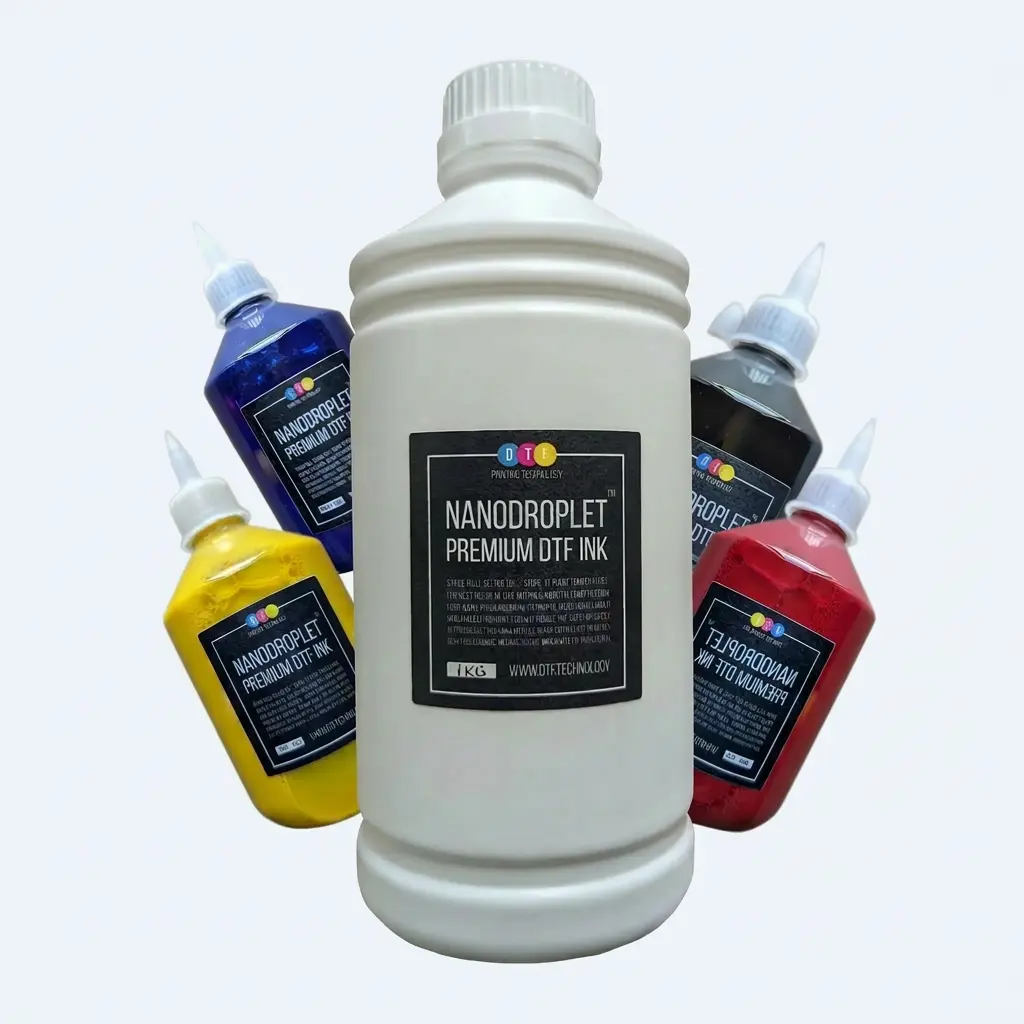
| DTF Ink (CMYK + White) | £40–£100 per litre | £0.10 – £0.40 |
| DTF Film (33cm x 100m roll) | £45–£110 per roll | £0.10 – £0.20 |
| Adhesive Powder (1kg) | £20–£40 per kg | £0.03 – £0.10 |
| Electricity | Variable | £0.05 – £0.15 |
| Maintenance & Cleaning | £30–£60/month | Variable |
| TOTAL COST PER A4 TRANSFER | – | £0.30 – £0.85 |
Ordering Transfers: The Outsourcing Option
Equipment Needed
When outsourcing your DTF transfers, your equipment needs are minimal:
- Heat Press (40x50cm): £200–£500
- Teflon Sheets: £10–£20
- Total Startup Cost: £210–£520
UK Transfer Supplier Pricing (2026)
Here’s what UK trade suppliers are charging for ready-to-press DTF transfers:
| Product | Price (+ VAT) | Cost Per Design* |
| Gang Sheet (1 metre) 55-57cm x 100cm | £8.50 – £13.00 | £0.50 – £2.50 |
| Gang Sheet (½ metre) 55-57cm x 50cm | £7.50 – £9.50 | £0.75 – £3.00 |
| Individual A3 Transfer | £4.00 – £7.00 | £4.00 – £7.00 |
| Individual A5 Transfer | £2.50 – £4.00 | £2.50 – £4.00 |
| Bulk Gang Sheets (20+ metres) | £7.00 – £9.00/m | £0.40 – £1.50 |
*Cost per design depends on how efficiently you fill your gang sheet. A 1-metre gang sheet can fit approximately 6 large (28x33cm) designs at ~£1.50–£2.20 each, or 18+ smaller designs at ~£0.50–£0.85 each.
Popular UK DTF Transfer Suppliers
- DTF.Technology– Gang sheets from £7.99/metre, A4 sheets from £1.50, Same day dispatch
- DTF.UK – Gang sheets from £10/metre, next-day dispatch
- Beyond Colour Transfers – From £10+VAT/metre, 9-colour printing available
- DTF Transfer UK – From £2.50 for individual transfers, gang sheets available
- DTF Gang Sheet Printing – £10+VAT/metre, trade pricing available
- Future Transfers – Gang sheet builder, A3/A5 options
Head-to-Head Comparison
Break-Even Analysis
Let’s calculate when buying your own printer becomes more economical than outsourcing:
Assumptions:
- Entry-level in-house setup: £3,500 total investment
- In-house cost per A4 transfer: £0.50 (including consumables)
- Outsourced cost per transfer: £1.50 (using gang sheets efficiently)
- Saving per transfer with in-house: £1.00
Break-even point: £3,500 ÷ £1.00 = 3,500 transfers
At 50 transfers per week, you’d break even in approximately 70 weeks (about 16 months). At 100 transfers per week, you’d break even in 35 weeks (about 8 months). At 200 transfers per week, you’d break even in just 17-18 weeks (about 4 months).
Pros and Cons Summary
In-House DTF Printing
Advantages:
- Lowest per-transfer cost at volume (£0.30–£0.85)
- Complete control over production timing
- Instant turnaround for rush orders
- No minimum order quantities
- Can sell transfers as additional revenue stream
Disadvantages:
- Significant upfront investment (£2,000–£10,000+)
- Learning curve and potential for wasted materials
- Daily maintenance required to prevent clogs
- Space requirements for equipment
- Risk if business doesn’t grow as expected
Outsourcing Transfers
Advantages:
- Minimal startup cost (just need a heat press)
- Zero maintenance or technical knowledge required
- Professional quality from day one
- Low risk-scale up or down easily
- Focus on sales and marketing instead of production
Disadvantages:
- Higher per-transfer cost (£0.50–£4.00+ depending on volume)
- Dependent on supplier turnaround times (usually 1-3 days)
- Shipping costs add up
- Less flexibility for last-minute changes
Our Recommendations
Start with Outsourcing If…
- You’re just starting and testing the market
- You have limited capital (under £2,000 to invest)
- You’re unsure about demand for your products
- You don’t have dedicated space for equipment
- You want to focus on design and sales, not production
- You’re printing fewer than 50 transfers per week
Invest in Your Own Printer If…
- You have consistent demand (100+ transfers per week)
- You have £3,000–£5,000+ to invest
- You need same-day turnaround for customers
- You want to offer transfer printing as an additional service
- You have space and time for equipment maintenance
- You’re committed to the business long-term
The Hybrid Approach
Many successful businesses use both methods. Consider:
- Start with outsourcing to validate your business concept and build a customer base
- Track your volume carefully over 3-6 months to understand real demand
- Invest in a printer once you’re consistently hitting 75-100+ transfers per week
- Keep supplier relationships for overflow orders or specialty transfers you can’t produce
Final Thoughts
The beauty of DTF printing in 2026 is that you don’t have to make an all-or-nothing decision. UK trade suppliers have made it incredibly affordable to start a custom apparel business with minimal risk. You can literally begin with just a £300 heat press and start taking orders tomorrow.
As your business grows and you gain confidence in your market, transitioning to in-house production becomes a natural next step. By then, you’ll have real data on your volumes, peak seasons, and popular designs-making the investment decision much clearer.
Remember: the goal isn’t to have the fanciest equipment. It’s to build a profitable business. Sometimes the smartest investment is the one you don’t make until you’re ready.
Good luck with your DTF journey!