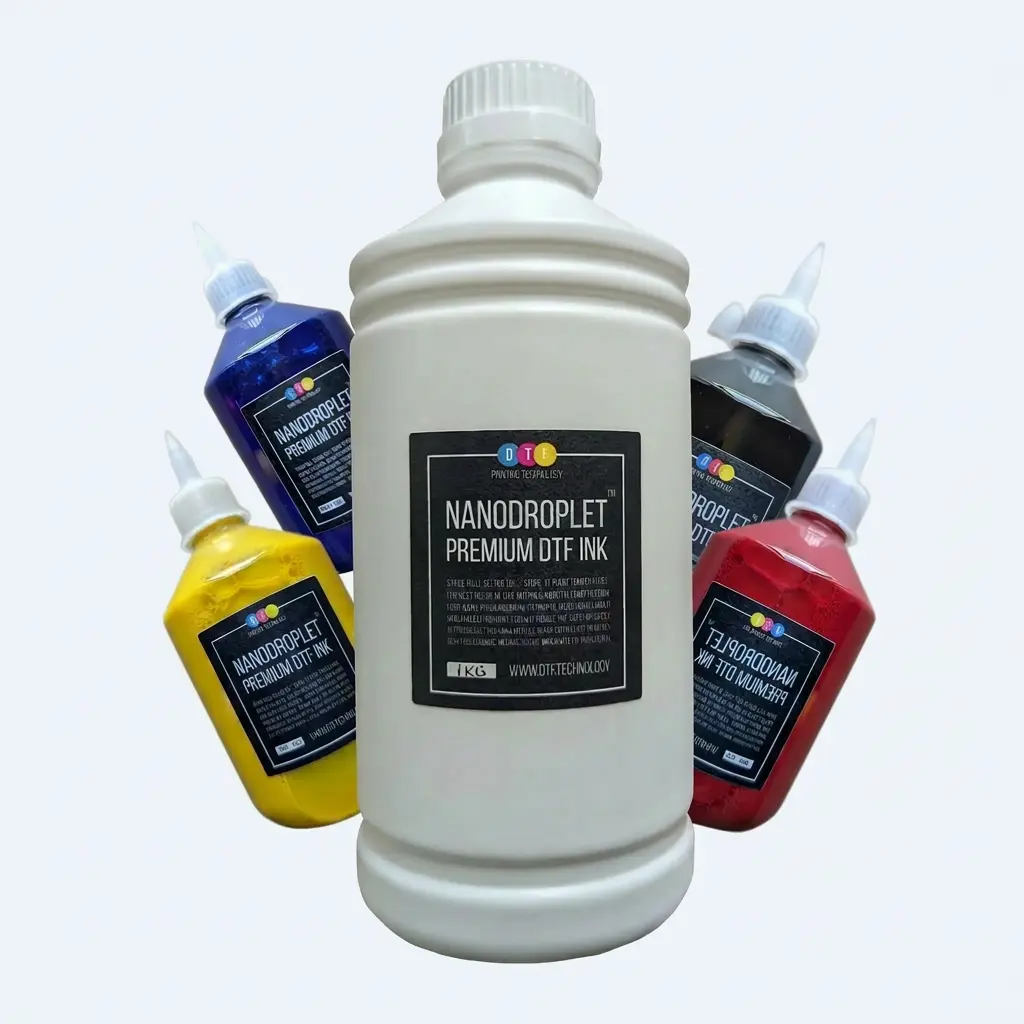
DTF Ink
Nanodroplet DTF ink - CMYK+White sets, low sediment white ink, and UV DTF ink
From £5.00 ex. VAT
About Nanodroplet DTF Ink
DTF ink is a specialist water-based pigment ink formulated for direct-to-film printing. Unlike standard inkjet ink, DTF ink is engineered to bond with PET film and adhesive powder to create transfers that can be heat-pressed onto fabric. The pigment particles are finer, the viscosity is tuned for DTF printheads, and the colour gamut is optimised for textile reproduction. You cannot substitute regular inkjet or sublimation ink - they will not adhere to DTF film correctly and will produce poor wash durability.
We stock three categories of DTF ink. CMYK+White sets include all five colours needed for DTF printing - the four process colours create your image, and white provides the opaque base layer that makes designs pop on dark garments. Low Sediment White is a standalone white ink with a soft sediment formulation that keeps the heavy white pigment particles in suspension for longer, reducing the settling and clogging that plagues most DTF printers. UV DTF ink is for a different process entirely - it is a hybrid UV-curable ink that works with UV DTF printers to create peel-and-stick transfers for hard surfaces like phone cases, tumblers, mugs, and signage. Our UV DTF ink uses a neutral hybrid formulation that balances flexibility and hardness, so it adheres to both rigid and semi-flexible substrates without cracking or peeling.
White ink is where most DTF users run into trouble. The titanium dioxide pigment used in white ink is significantly heavier than CMYK pigments, which means it settles faster in bottles, ink lines, and printhead channels. This settling is the number one cause of clogged nozzles and inconsistent output. You will see some sellers marketing "no sediment" white ink - that is misleading. All white DTF ink contains sediment because that is what the titanium dioxide pigment is. The real question is what kind of sediment it produces. Soft sediment (sometimes called low sediment) does not solidify over time. It can be stirred or shaken back into suspension in the ink tank or bottle. Hard sediment is the opposite - it cakes at the bottom and cannot be remixed, eventually blocking your ink lines permanently. Our low sediment white ink produces soft sediment that stays mixable, which means less clogging, less wasted ink, and a longer life for your printhead. Even with soft sediment ink, regular circulation and basic maintenance are still necessary - watch the video below to see the difference in practice.
All our standard DTF ink is compatible with Epson-based DTF printers, including machines using DX5, DX7, XP600, i3200, i1600, and L1800 printheads. Sets are available from 100ml (enough for testing or light use) up to 1kg bottles for production environments. Whichever size you choose, keep your printer maintained with the right cleaning supplies - regular nozzle checks and head cleans make a real difference to print quality and ink longevity.
Choosing the Right DTF Ink
There are three distinct product types on this page, and they serve different purposes. Here is what you need to know to pick the right ink for your setup.
CMYK+White Ink Sets
Each CMYK+White set contains five bottles - one each of Cyan, Magenta, Yellow, Black, and White. All five colours are required for standard DTF printing. The CMYK channels reproduce your artwork, and the white channel prints the opaque base layer underneath. Without white ink, your designs will be semi-transparent on dark fabrics.
If you are just getting started with DTF, a 200ml set is the most practical starting point. It gives you enough ink to learn your printer, dial in your colour profiles, and produce a reasonable number of prints before needing to reorder. The 100ml set works for a quick test run or evaluation, but you will get through it faster than you expect - white ink in particular gets used on every single print. For regular production, the 500ml set offers noticeably better value per millilitre. The 1kg set is aimed at established operations printing daily.
Low Sediment White Ink
White DTF ink is the most troublesome consumable in the entire DTF workflow. The titanium dioxide pigment that gives white ink its opacity is significantly denser than the pigments in CMYK ink. This means it settles - in the bottle, in the ink lines, in the dampers, and inside the printhead channels. Left unchecked, settling leads to clogged nozzles, banding, faded white output, and eventually a printhead that needs replacing.
A common misconception: some sellers market their white ink as "no sediment." This is misleading. All white DTF ink produces sediment - the titanium dioxide pigment that makes the ink white is heavier than the carrier fluid, so it will always settle over time. The important distinction is between soft sediment and hard sediment. Soft sediment does not solidify. It stays loose and can be shaken or stirred back into suspension in the bottle or ink tank. Hard sediment cakes at the bottom and becomes permanent - once it hardens, it cannot be remixed, and it will block your ink lines and printhead channels beyond recovery.
Our low sediment white ink produces soft sediment. The improved dispersant package keeps the pigment in suspension for substantially longer than standard white ink, and when it does settle, it remixes easily with a good shake. It is not a magic fix - you still need to shake the bottle before refilling, run regular maintenance, and keep your ink circulating - but it significantly reduces the frequency of white-ink-related problems. We particularly recommend it if you print fewer than five days a week, if your printer sits idle over weekends, or if you have already experienced white ink clogging. Many users buy a standard CMYK+White set for the colour channels and then purchase low sediment white separately for the white channel.
UV DTF Ink
UV DTF ink is for a completely different process. Where standard DTF targets textiles, UV DTF is designed for hard and smooth surfaces - phone cases, tumblers, mugs, notebooks, promotional items, and signage. UV DTF ink is oil-based and cures instantly under ultraviolet LED light through a chemical reaction called photopolymerisation, rather than bonding through heat and adhesive powder. You need a UV-curable printer to use it, and the film and workflow are different from standard textile DTF. If you are only printing onto garments, you do not need UV DTF ink.
Our UV DTF ink uses a neutral hybrid formulation - it sits between hard UV ink and soft UV ink. Hard UV ink produces a tough, scratch-resistant but brittle finish that works well on rigid surfaces like glass and metal but cracks on anything with flex. Soft UV ink is flexible enough for leather and vinyl but scratches easily on hard materials. The hybrid formula blends both properties: it is flexible enough to handle slight curves and bending while still providing good scratch resistance on rigid substrates. This means you can use one ink set across a wider range of products - from flat acrylic signs to curved tumblers - without switching formulations. The neutral pH is also gentler on printhead components, which helps keep maintenance costs down.
UV DTF prints come off the printer as finished peel-and-stick transfers. No heat press needed - you clean the surface, peel the backing, and press the transfer on by hand or with a roller. The result is a waterproof, UV-resistant, scratch-resistant decal that holds up outdoors. Many DTF businesses run both standard DTF for garments and UV DTF for hard goods, covering virtually every customisation substrate with two processes.
Size Recommendations by Volume
- 100ml - Testing a new printer, evaluating ink quality, or very occasional hobby use. Expect roughly 50-100 A4 prints depending on ink coverage.
- 200ml - Small business or active hobbyist printing a few times a week. A sensible starting point that balances cost and commitment.
- 500ml - Regular production work. The sweet spot for value per millilitre if you are printing most days.
- 1kg - High-volume operations running daily. Lowest cost per millilitre and fewer reorder cycles.
Remember that white ink is consumed faster than any individual CMYK colour because it is used as a base layer on every print. Budget for extra white ink - roughly two to three times the volume of any single CMYK colour over the same period.
Printer Compatibility
Our DTF ink is formulated for Epson-based printheads, which covers the vast majority of DTF printers on the market. Compatible printhead models include the DX5, DX7, XP600, i3200, i1600, and L1800. If you are using a dedicated DTF machine from brands like Prestige, Procolored, or DTF Station, this ink will work. If you have converted an Epson inkjet printer (such as the L1800 or ET-8550) for DTF use, it is also compatible. Check your printer documentation or contact us if you are not sure which printhead your machine uses.
For guidance on setting up your printer and getting your first prints right, see our getting started guide. And keep cleaning supplies on hand - regular maintenance is the single most effective way to extend the life of your ink and your printhead.
Industrial Material Data Sheet
Standardised technical specifications for water-based DTF pigment ink, soft sediment white ink, and hybrid UV-curable ink. Covers ink chemistry, rheology, sedimentation engineering, and UV photopolymerisation data.
Standard DTF Ink - Fluid Dynamics
| Ink Classification | Water-based pigment ink |
|---|---|
| Carrier Fluid | Deionised water + glycol co-solvents |
| Pigment Particle Size | < 200nm (sub-micron, precision milled) |
| Viscosity (CMYK) | 3.5 - 6.0 mPa·s at 22°C |
| Viscosity (White) | 10 - 30 mPa·s at 22°C |
| Surface Tension | 28 - 35 mN/m |
| pH Range | 7.0 - 9.0 |
| Colour Restoration | ≥ 90% accuracy vs. digital source file |
| Jetting Method | Piezoelectric drop-on-demand |
| Nozzle Aperture Compatibility | 20 - 50µm |
White Ink - Titanium Dioxide Chemistry
| White Pigment | Rutile titanium dioxide (TiO2) |
|---|---|
| TiO2 Crystal Structure | Rutile (most thermodynamically stable) |
| Refractive Index (Rutile) | n = 2.75 |
| TiO2 Particle Density | ~4.2 g/cm³ |
| Carrier Fluid Density | 1.0 - 1.2 g/cm³ |
| Density Differential | ~3.5× (pigment vs. carrier) |
| TiO2 Loading | 15 - 30% by weight |
| Surface Treatment | Alumina/silica coating for dispersibility |
| Opacity (single pass) | High (optimised for white underbase) |
Soft Sediment Engineering
All white DTF ink sediments. This is a physical certainty, not a quality defect. Rutile TiO2 has a density of approximately 4.2 g/cm³ - over three times heavier than the water-based carrier fluid at 1.0-1.2 g/cm³. Gravity will always pull these particles downward over time. The marketing claim of "no sediment" white ink is a false proposition. The engineering distinction that matters is between soft sediment and hard sediment.
| Sediment Type | Behaviour |
|---|---|
| Soft Sediment | Loose, non-solidifying precipitate. Can be shaken or stirred back into uniform suspension. Does not block ink lines or printhead channels. Remixable after weeks of storage. |
| Hard Sediment | Caked, solidified precipitate. Cannot be remixed. Permanently blocks ink lines, dampers, and printhead channels. Requires physical cleaning or component replacement. |
How Soft Sediment Formulation Works
Our soft sediment white ink uses a super-dispersant package that wraps each TiO2 nanoparticle in a charged molecular shell. The like charges at the dispersant tails create electrostatic repulsion between particles, preventing them from aggregating into dense clusters. A secondary steric hindrance mechanism - where the dispersant polymer chains physically block particle-to-particle contact - provides a second layer of anti-aggregation protection.
The result is that sedimentation rate is reduced by 60-70% compared to standard white ink formulations, and critically, any sediment that does form remains soft and loose. A physical gel-network of dispersant molecules creates a low-shear-strength scaffold in the ink that holds particles in a quasi-suspended state during storage. When you shake the bottle, this network breaks instantly and reforms once the ink is still again - the particles redistribute uniformly with minimal effort.
This is what "soft sediment" means in practice: not the absence of settling, but the guarantee that settled pigment never solidifies and always remixes. It is the difference between a bottle that needs a shake before use and a bottle that needs replacing because the bottom has turned into cement.
Hybrid UV Ink - Photopolymerisation Data
| Ink Classification | Hybrid UV-curable ink (neutral formulation) |
|---|---|
| Carrier Base | Oil-based monomer/oligomer system |
| Curing Method | UV LED photopolymerisation (free radical) |
| Curing Wavelength | 365 - 405nm (UV-A / LED-UV) |
| Cure Speed | Instant (inline UV exposure) |
| Odour Profile | Low odour formulation |
| Ink Consumption | ~8 - 10 ml/m² (vs. 12-14 ml/m² solvent) |
Hybrid UV - Mechanical & Adhesion Properties
| Stretch Factor | 300%+ without cracking |
|---|---|
| Thermoformability | Heat-bendable (suitable for vacuum/pressure forming) |
| Hardness Profile | Neutral hybrid (between hard UV and soft UV) |
| Scratch Resistance (rigid) | High |
| Flexibility (curved surfaces) | High (no cracking on bends) |
| Edge Chipping Resistance | Excellent (router, guillotine, and high-speed knife cut) |
| Weatherability | UV resistant, waterproof |
| Application Method | Peel-and-stick (no heat press required) |
Hybrid UV - Substrate Compatibility
| Acrylics (PMMA) | Direct adhesion without primer |
|---|---|
| Foamboard | Direct adhesion without primer |
| Polystyrene | Direct adhesion without primer |
| Expanded PVC (Foamex) | Direct adhesion without primer |
| Rigid Polyethylene | Direct adhesion without primer |
| Fluted Polypropylene (Correx) | Direct adhesion without primer |
| Glass & Ceramics | Good adhesion (surface prep recommended) |
| Metal & Aluminium | Good adhesion (surface prep recommended) |
Note: Adhesion performance depends on curing conditions, substrate age, and manufacturer. Always test adhesion on a sample piece before production runs.
Understanding the Three Ink Types
Water-Based DTF Pigment Ink (Textile Transfers)
Standard DTF ink is a water-based dispersion of sub-200nm pigment particles in a deionised water and glycol co-solvent system. The viscosity is tuned to 3.5-6 mPa·s for CMYK channels - thin enough to jet through 20-50µm piezoelectric nozzle apertures without satellite droplets, thick enough to carry pigment load without dripping. Surface tension is controlled at 28-35 mN/m using surfactant additives that promote proper wetting on PET film without excessive spreading.
The pigment particles sit on the film surface rather than penetrating it - unlike dye-based inks where the colourant dissolves into the substrate. This surface-sitting behaviour is what allows the TPU adhesive powder to bond around the pigment and carry it onto fabric during heat pressing. It also means DTF prints maintain colour vibrancy through washing, as the pigment is physically locked under the adhesive layer rather than exposed to detergent.
Soft Sediment White Ink (The TiO2 Problem, Solved)
White ink is the single most maintenance-intensive consumable in DTF printing. The titanium dioxide pigment that provides opacity has a density 3.5 times greater than the carrier fluid. This density differential drives continuous sedimentation in bottles, ink tanks, ink lines, dampers, and printhead channels. Standard white ink formulations produce hard sediment over days to weeks - solidified deposits that permanently block fluid pathways and destroy printheads.
Our soft sediment formulation addresses this at the molecular level. Super-dispersant molecules adsorb onto each TiO2 particle surface, creating a charged shell that prevents particle-to-particle aggregation through electrostatic repulsion and steric hindrance. A physical gel-network in the ink holds particles in quasi-suspension during storage, breaking instantly under shear (shaking) and reforming at rest. The practical result: 60-70% slower sedimentation rate, and any precipitate that forms remains soft and remixable - not hardened cement.
Hybrid UV-Curable Ink (Hard Surface Transfers)
UV DTF ink is a fundamentally different chemistry from water-based textile DTF ink. It is an oil-based system of reactive monomers and oligomers that polymerise instantly when exposed to UV LED light at 365-405nm - a process called free-radical photopolymerisation. There is no drying, evaporation, or heat curing involved. The UV exposure triggers a chain reaction that converts the liquid ink into a solid polymer film in milliseconds.
Our hybrid UV formulation sits at the neutral point between hard UV and soft UV ink chemistries. Hard UV ink produces a rigid, scratch-resistant but brittle cured film - excellent on glass and metal but it cracks on any surface with flex. Soft UV ink is flexible enough for leather and vinyl but scratches easily on rigid substrates. The hybrid neutral formula achieves both: a 300%+ stretch factor without cracking (making it suitable for thermoforming, vacuum forming, and pressure forming on curved objects), combined with high scratch resistance and excellent edge-chipping resistance when used with router cutters, guillotines, or high-speed knife cutters on rigid substrates.
The low-odour formulation and primerless adhesion to common signage substrates (acrylics, foamboard, polystyrene, expanded PVC, rigid polyethylene, fluted polypropylene) make it suitable for both open-plan workshop environments and high-throughput production. The ~8-10 ml/m² ink consumption rate is approximately 30% more efficient than equivalent solvent-based systems.
Technical Specifications
| Ink type (standard DTF) | Water-based pigment ink |
|---|---|
| Ink type (UV DTF) | Hybrid UV-curable ink (neutral formulation) |
| Colours | Cyan, Magenta, Yellow, Black, White |
| White pigment | Rutile titanium dioxide (TiO₂) |
| White ink formulation | Soft sediment - super-dispersant wrapped TiO₂ nanoparticles |
| Viscosity | 3.5 - 6 mPa·s at 22°C (CMYK) / 10 - 30 mPa·s (White) |
| Particle size | < 200nm (sub-micron pigment) |
| Surface tension | 28 - 35 mN/m |
| pH | 7.0 - 9.0 |
| Shelf life | 12-18 months (sealed), 6 months (opened) |
| Printhead compatibility | Epson DX5, DX7, XP600, i3200, i1600, L1800 |
| UV ink stretch factor | 300%+ without cracking (thermoformable) |
| Working environment | 20-28°C, 40-60% humidity |
| Storage | 15-30°C, sealed, upright, away from sunlight |
| Safety | Non-toxic, water-based, REACH compliant |
Key Features
Frequently Asked Questions
What's included in a CMYK+W ink set?
What is low sediment white ink and do I need it?
What size ink set should I buy?
What is UV DTF ink for?
Is this ink compatible with my printer?
How long does DTF ink last once opened?
Why does my white ink keep clogging?
Is DTF ink safe to use?
How should I store DTF ink?
What makes hybrid UV ink different from standard UV ink?
What does soft sediment actually mean?
Can I use hybrid UV ink for thermoforming?
Learn More About DTF Ink
How to Start DTF Printing: Beginner's Guide 2026
Everything you need to start DTF printing in the UK. Equipment list, realistic startup costs, your first print walkthrough, and common mistakes to avoid.
DTF Printing Troubleshooting: Common Problems & Fixes
Fix common DTF printing problems. White ink clogging, banding, poor adhesion, colour issues, and more. Practical solutions from working DTF printers.
DTF vs DTG Printing: Complete Guide 2026
Honest comparison of DTF and DTG printing for UK businesses. Costs, quality, fabric compatibility, and which method suits your setup. Written by working printers.


.webp)